
Key takeaways
- A listing promises mat removal but does not explain blade type, replacement availability, or motor settings.
- The clipper has only a tiny detail blade but is presented as suitable for full-body grooming of large, dense-coated dogs.
- Guide combs feel loose, bend easily, or lack clear length markings.
- The unit cannot operate while charging and offers less than 60 minutes of runtime for a large-dog grooming job.
- There is no clear warranty period, customer support contact, or source for replacement blades.
- The product encourages clipping a dirty, wet, or heavily matted coat without warning about pulling, blade damage, or skin injury.
What's inside
Choosing dog clippers for a thick coat is less about finding the loudest motor claim on the box and more about matching the tool to your dog’s coat density, grooming routine, and tolerance for noise and vibration. Heavy double coats, curly coats, dense undercoats, and lightly matted fur can quickly overwhelm a basic trimmer designed for occasional touch-ups.
The most common mistake is buying a low-cost clipper with a narrow blade and expecting it to shave a thick-coated dog in one pass. Another is using clippers on mats that should first be brushed, split safely, or handled by a professional groomer. Buyers also tend to focus on attachment comb count rather than blade quality, battery capacity, heat management, and whether replacement blades are readily available.
As an Amazon Associate we earn from qualifying purchases at no extra cost to you. Product prices and availability are accurate as of the date shown and are subject to change.


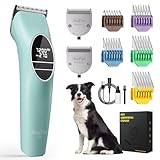
For 2026, the practical goal is simple: choose a clipper that can move through a clean, fully brushed coat without pulling, overheating quickly, or forcing you to make repeated passes over the same area.
Decide These 3 Things First
- How thick is the coat really? A short, smooth coat needs only a light-duty trimmer for paws and sanitary areas. A dense double coat, doodle-style curl, woolly coat, or coat with frequent tangling calls for a higher-torque clipper and a quality detachable or adjustable blade system.
- Are you doing full-body haircuts or maintenance work? For feet, face, pads, and hygiene trims, a compact clipper with a 30- to 60-minute runtime may be enough. Full-body grooming generally calls for 90 to 180 minutes of cordless use, corded backup, and a blade width around 1.75 inches.
- Will you maintain the coat between cuts? Clippers are not a substitute for brushing. If your dog is prone to mats, plan on using a slicker brush, comb, and de-shedding or dematting tools before clipping. Even a $60 clipper can snag if it is asked to cut through packed debris, tight mats, or a wet, dirty coat.
Clipper Size and Blade Width
Physical size affects control. A typical full-size cordless dog clipper measures roughly 7 to 8.5 inches long and weighs about 10 to 16 ounces. That range is manageable for most at-home users while still leaving room for a larger motor and battery. Compact trimmers often measure 5 to 6.5 inches and weigh 5 to 8 ounces; they are useful companions for detail work but are rarely the best primary tool for a thick full coat.
Blade width matters as much as body size. Most full-size clippers use a blade approximately 1.75 inches wide. This is the standard working width for body grooming because it covers enough area without becoming difficult to maneuver around shoulders, legs, and the belly. Narrow detail blades may be closer to 1 inch wide and are better for paws, eye corners, ears, and sanitary trimming.
For thick coats, look for a full-size clipper that accepts either a standard adjustable blade or detachable professional-style blades. Adjustable blades are convenient for household grooming because one blade can shift between close and longer settings. Detachable blades cost more, but they can be swapped when hot, cleaned more thoroughly, and matched to specific coat lengths.
Blade Material and Comb Materials
A thick coat creates friction, so blade material is a serious buying factor. Stainless-steel blades are common and affordable. They can work well for routine grooming, but they need cleaning, oiling, and eventual replacement. Ceramic moving blades are often marketed for staying cooler during longer sessions. They can reduce heat buildup, although they are more brittle than steel and should not be dropped.
A sensible setup for home use is a stainless-steel fixed blade paired with a ceramic moving cutter, or a well-made all-steel blade from a brand that sells replacements. Avoid treating “titanium-coated” as a guarantee of superior performance; coating can be useful, but motor strength, blade alignment, and maintenance still determine whether the clipper pulls through dense fur.
Attachment combs are usually plastic or reinforced plastic. Look for combs that lock firmly onto the blade rather than loosely snapping over it. A useful home set typically includes guides from about 1/8 inch to 1 inch, or 3 mm to 25 mm. For thick or curly hair, metal-reinforced comb teeth are preferable because they are less likely to flex, bend, or pop off when meeting resistance.
Motor Construction and Power Delivery
Manufacturers often list motor speed in revolutions per minute (RPM), but RPM alone does not tell the full story. A fast motor that loses torque in dense fur can still bog down. For thick coats, seek a clipper described as heavy-duty, high-torque, or designed for dense and matted hair, ideally with more than one speed setting.
Many consumer dog clippers advertise speeds between 5,000 and 7,000 RPM. That can be adequate for regular home grooming when the dog is brushed out first. More demanding coats benefit from a clipper with a stronger motor design, a stable power supply, and a blade that does not stall under moderate pressure.
Battery construction also matters. Lithium-ion batteries are the usual choice because they are lighter and hold a charge well. A practical target is 90 minutes of runtime after a 2- to 4-hour charge. For large dogs or multi-dog homes, choose 120 to 180 minutes of advertised runtime, or prioritize a cord/cordless model that can run while plugged in. A removable battery can be useful, but only if replacements are easy to purchase.
Example kits in the roughly $40 to $65 range, including options from oneisall and AngFan, may suit routine at-home thick-coat grooming when paired with thorough brushing and realistic expectations. Compare their included blades, battery claims, comb construction, and corded-use capability rather than assuming a larger accessory count means stronger cutting power.
Comfort, Noise, and Real-World Performance
A clipper can be technically powerful and still be unpleasant to use if it is too heavy, slippery, loud, or vibration-heavy. For most people, 11 to 14 ounces is a comfortable range for a full-size cordless unit. Heavier models can feel more substantial, but hand fatigue becomes noticeable during a 45- to 90-minute grooming session.
Look for a textured grip and a body diameter that fits securely in your hand. A body around 1.75 to 2.25 inches wide is common. Controls should be easy to locate without changing your grip, especially if you need to turn the clipper off quickly around a nervous dog.
Noise ratings are not always independently measured, so treat ultra-quiet claims carefully. In practical terms, a lower-pitched, low-vibration clipper is often easier for sound-sensitive dogs than a high-pitched unit, even if neither provides a verified decibel rating. Introduce the clipper gradually: run it near the dog without cutting, reward calm behavior, then start with a small, easy area.
Check blade temperature every 5 to 10 minutes during dense-coat work. Turn the clipper off, touch the blade carefully, and switch or pause if it feels hot. Blade coolant can help, but it does not replace proper cleaning and oiling.
Price Tiers and What You Get
Budget: $30 to $50. Expect a cordless clipper, several plastic guide combs, a cleaning brush, oil, and perhaps small scissors or a comb. This tier can work for occasional grooming on a well-maintained thick coat, but blade durability, comb fit, and battery consistency vary. The $39.98 oneisall thick heavy coat clipper is representative of the entry-level range.
Mid-range: $50 to $90. This is the sweet spot for many owners with dense-coated dogs. Look for longer runtime, improved motor torque, stronger combs, better grip design, and useful extras such as a detail trimmer. The $54.99 oneisall heavy-duty kit, $59.99 AngFan kit, and $64.84 oneisall 4-in-1 kit fall around this range. Evaluate whether accessories are genuinely useful rather than paying more for duplicate brushes or novelty attachments.
Premium: $100 to $250 or more. At this level, buyers should expect more durable construction, serviceable parts, stronger continuous-duty performance, and access to compatible detachable blades. Premium clippers make the most sense for very large dogs, frequent grooming, multiple pets, or owners who want a tool closer to professional equipment.
Warranty, Replacement Parts, and Support
A one-year limited warranty is common for consumer grooming clippers. That is a reasonable baseline, but read what is covered. Batteries, blades, attachment combs, and accidental damage may have shorter coverage or be excluded altogether.
More important than a long warranty is whether you can replace wear items. Before buying, confirm that replacement blades, charging cables, batteries if applicable, and attachment combs are available. A clipper body may last several years, but a dull blade can make it feel unusable much sooner.
Plan to oil the blade before first use, after cleaning, and during extended sessions. With regular maintenance, a replacement blade is usually more economical than replacing an entire clipper kit.
Delivery, Setup, and Assembly
Dog clippers require little assembly, but setup should not be rushed. Most kits arrive with the blade installed, a charging cable, blade oil, a brush, and guide combs. Charge the unit fully before the first long grooming session; initial charging commonly takes 2 to 4 hours, though the instruction manual for the specific model should take priority.
Before clipping, remove the blade guard, add 1 or 2 small drops of clipper oil along the blade teeth, run the clipper for 5 to 10 seconds, and wipe away excess oil. Test each guide comb to ensure it fits securely. Never force a comb through a mat; brush and comb the coat until the comb can pass through freely.
For a first full groom, allow 60 to 120 minutes including breaks, brushing, and cleanup. Start with a longer guard than you think you need. You can always go shorter, but an overly close cut is difficult to correct and may expose sensitive skin.
Spec Checklist
| Spec | Budget | Mid | Premium |
|---|---|---|---|
| Typical price | $30-$50 | $50-$90 | $100-$250+ |
| Clipper weight | 12-16 oz | 10-14 oz | 11-16 oz |
| Advertised runtime | 60-90 min | 90-180 min | 120-240 min or swappable battery |
| Charge time | 3-5 hr | 2-4 hr | 1-3 hr, depending on system |
| Blade system | Basic adjustable steel blade | Adjustable steel/ceramic or improved steel blade | Detachable professional blade system |
| Best use | Occasional maintenance | Regular home grooming for thick coats | Frequent full-body grooming and multi-dog homes |
| Recommended backup | Charging cable | Corded operation or detail trimmer | Second blade and backup battery |
Red Flags
- A listing promises mat removal but does not explain blade type, replacement availability, or motor settings.
- The clipper has only a tiny detail blade but is presented as suitable for full-body grooming of large, dense-coated dogs.
- Guide combs feel loose, bend easily, or lack clear length markings.
- The unit cannot operate while charging and offers less than 60 minutes of runtime for a large-dog grooming job.
- There is no clear warranty period, customer support contact, or source for replacement blades.
- The product encourages clipping a dirty, wet, or heavily matted coat without warning about pulling, blade damage, or skin injury.
FAQ
What kind of clippers are best for dogs with thick coats?
A full-size, high-torque clipper with a 1.75-inch blade, at least 90 minutes of runtime, and sturdy guide combs is a strong starting point. For especially dense, curly, or frequently matted coats, a model that accepts detachable blades offers more flexibility and easier heat management.
Can I use dog clippers on a matted coat?
Light tangles should be brushed out before clipping. Tight mats can pull skin into the blade path and are risky to remove at home, particularly around ears, armpits, groin areas, and joints. Seek a professional groomer or veterinarian if mats are close to the skin or causing discomfort.
How often should I oil dog clipper blades?
Oil before use, after cleaning, and every 10 to 15 minutes during extended grooming. Use clipper oil rather than household lubricants. Clean fur from the blade after every session, and store the clipper dry with its blade guard in place.
Are cordless clippers powerful enough for thick dog hair?
Yes, many are, provided the coat is clean and thoroughly brushed. Choose a cordless model with a strong motor, at least 90 minutes of runtime, and corded-use capability if you groom large dogs or expect long sessions. A weak battery, dull blade, or packed undercoat will reduce performance regardless of whether the clipper is cordless or plugged in.


Write Your Review
No reviews yet. Be the first to share your experience!